

Introduction
The McLaren W1 Review 2026 is not just another supercar story, here is the truth. It is the arrival of a new-generation hybrid hypercar built for collectors, track drivers and performance lovers who want the next big name after the McLaren F1 and McLaren P1. Reviews of it can be found on AutoPicker and the full guide below covers all the things buyers, fans and researchers need to know before judging the W1.
At first glance, the McLaren W1 looks like a car built to answer one serious question: how far can McLaren push a road-legal machine, while keeping it emotional, usable and driver-focused? The W1 has a 4.0-liter twin-turbo V8 hybrid powertrain that produces 1275 PS and 1340 Nm of torque, does 0-100 km/h in 2.7 seconds and 0-200 km/h in 5.8 seconds with a top speed of 350 km/h, McLaren says.
Most hypercars chase numbers. The W1 also chases connection. It’s rear-wheel drive, it’s super-light for the power you’re getting, and it’s built around active aerodynamics, a carbon fiber construction and a cockpit that puts the driver right in the middle of everything. Car and Driver estimates the 2026 McLaren W1 will have an MSRP of about $2.1 million and that the 399-car production run is already sold out.
For AutoPicker readers, this McLaren W1 Full Review covers pricing, specs, features, performance, interior comfort, technology, safety, tires, rims, buyer advice, and comparisons against the Ferrari F80, Bugatti Tourbillon, Aston Martin Valkyrie, Porsche 918 Spyder, and McLaren P1. For more hybrid performance context, you can also read AutoPicker’s Lamborghini Revuelto Review, Aston Martin Vanquish Review, and Bugatti Chiron Review.
Overview
You should think of the W1 as McLaren’s new halo car, because it follows the legendary bloodline of the F1 and P1. The McLaren W1 Hypercar Review shows that the W1 isn’t really meant to be a comfortable grand tourer. It is rather a road-legal performance weapon designed for ludicrous acceleration, high speed stability, track precision and collector-grade exclusivity.
Unlike many modern hypercars, the W1 has a strong McLaren character. It doesn’t need all-wheel drive to get its power down. It directs its hybrid output to the rear wheels through an 8-speed dual-clutch transmission, giving it a more conventional and more theatrical supercar character. That detail counts because the W1 is not just about being quick, it’s about making the driver feel involved.
The biggest headline at the heart of this McLaren W1 Detailed Review is the powertrain. The W1 combines a twin-turbo V8 with an electric motor to deliver 1258 bhp, and the electric system aids in enhancing throttle response and acceleration. The V8 alone is said to make 916 hp, with the electric motor adding 342 hp, according to Car and Driver.
If you’re comparing generations, the W1 is the spiritual successor to the McLaren P1, but it takes the formula further, with more power, more sophisticated aero, a lighter and more focused structure and a more aggressive track mission. And this is the reason why the McLaren W1 vs McLaren P1 talk is already one of the most interesting topics in the hypercar world.
Key Features
The first thing that really pops up is the hybrid V8 drivetrain. In this McLaren W1 V8 Hybrid Review, we can confirm that the W1 uses a 4.0-litre twin-turbo V8 and electric assistance to deliver immense performance without losing the mechanical emotion that McLaren buyers expect.
The second great feature is that of aerodynamics. The W1 has active aero, with an active rear wing system to boost downforce and stability at speed. Car and Driver says the W1 can generate as much as 2,205 pounds of downforce, while McLaren says its active Long Tail rear wing can extend as much as 11.8 inches rearward.
The third important feature is a carbon fiber build. The McLaren W1 Carbon Fiber Review shows the use of lightweight materials keeping the car sharp, responsive and track-ready. A hypercar with 1200+ horsepower needs more than horsepower, it needs stiffness, balance and low weight.
The fourth big feature is the fixed-seat cockpit layout. Rather than adjusting the seat, McLaren adjusts the pedals, steering wheel and controls to match the driver. This results in a racing style cabin that is both performant and packaging efficient.
The fifth highlight is exclusivity. McLaren says production of the W1 is limited to 399 cars and allocation has already been assigned to customers with a waiting list. That makes the W1 a performance machine but a collector item too.
Pricing
Let’s talk money, because the McLaren W1 Price Review is just as extreme as the performance review. Car and Driver lists the 2026 McLaren W1 starting price at about $2,100,000, before personal options and market premiums.
For buyers, the real-world price may become much higher because all 399 cars are already allocated. Limited-production hypercars often trade above their original MSRP when demand is stronger than supply. That makes the McLaren W1 Price and Review important for collectors who want to understand both ownership cost and long-term desirability.
For value comparison, the W1 is cheaper than some ultra-limited rivals but still belongs in the top tier of modern hypercars. The Ferrari F80 and Bugatti Tourbillon sit in a similar world of hybrid performance, extreme engineering, and limited production, but each car uses a very different formula.
For AutoPicker readers asking about McLaren W1 Price and Specs, the simple answer is this: the W1 is expensive, already sold out, and built for buyers who want McLaren’s most powerful road car rather than a regular luxury supercar.
Pros & Cons
Pros
The biggest advantage is performance. The W1 delivers 1258 bhp, 988 lb-ft of torque, and a claimed 0–62 mph time of 2.7 seconds.
Another major strength is driver focus. The W1 keeps rear-wheel drive, hydraulic steering, and a cockpit layout that prioritizes control rather than luxury overload.
A serious benefit is exclusivity. With only 399 units planned, the W1 has immediate collector appeal.
A strong plus point is aerodynamics. Active aero helps the car stay planted on track and stable at high speed.
A final advantage is brand heritage. The W1 follows the McLaren F1 and P1, which gives it instant importance among modern hypercars.
Cons
The first drawback is availability. Most interested buyers cannot purchase one new because the full production run is already allocated.
The second concern is price. A starting figure around $2.1 million places the W1 far beyond normal supercar budgets.
The third limitation is practicality. Cargo space, visibility, entry, and daily usability will never match a grand tourer or luxury coupe.
The fourth issue is limited electric range. Car and Driver reports an electric-only range of about two miles, so the hybrid system focuses on performance rather than EV commuting.
The fifth point is maintenance cost. Track use, carbon components, bespoke tires, and hybrid hardware will make ownership expensive.
What’s New for 2027?
As of the time of writing there is no confirmed major model-year update for the McLaren W1 for 2027. The W1 is a low-volume halo hypercar, not a normal annual model with regular trim updates.
The big takeaway for buyers is timing of production and delivery. With the W1 already spoken for, the 2027 talks will likely be more about customer deliveries, rare specs, auction value and special MSO personalization rather than a garden-variety facelift.
For the SEO readers looking for the McLaren W1 Launch Review, the W1 launch means something because it was the next “1” car from McLaren after the P1. It also launched into a hypercar era with Ferrari, Bugatti, Aston Martin and Lamborghini all pushing hybrid or extreme performance flagship models.
Where This Vehicle Ranks
In AutoPicker’s ranking, the McLaren W1 sits near the top of modern hybrid hypercars because it combines extreme power, low weight, active aero, rear-wheel-drive drama, and genuine McLaren heritage.
Against the Ferrari F80, the W1 feels more focused on rear-drive purity, while the Ferrari uses a more complex hybrid setup with all-wheel-drive technology. The McLaren W1 vs Ferrari F80 comparison comes down to emotion versus system complexity.
Against the Bugatti Tourbillon, the W1 is lighter, more track-focused, and more driver-centered. The McLaren W1 vs Bugatti Tourbillon comparison is really about two philosophies: McLaren builds a razor-sharp hybrid V8 track weapon, while Bugatti builds a luxury V16 hybrid masterpiece.
Against the Aston Martin Valkyrie, the W1 may feel more usable and more modern in its hybrid delivery. The McLaren W1 vs Aston Martin Valkyrie debate is about road usability, track drama, and how much race-car character a buyer wants.
Against the Porsche 918 Spyder, the W1 represents a newer generation of hybrid hypercar thinking. The McLaren W1 vs Porsche 918 Spyder comparison shows how far battery, aero, and carbon architecture have moved since the original hybrid hypercar trio.
Engine, Transmission & Performance
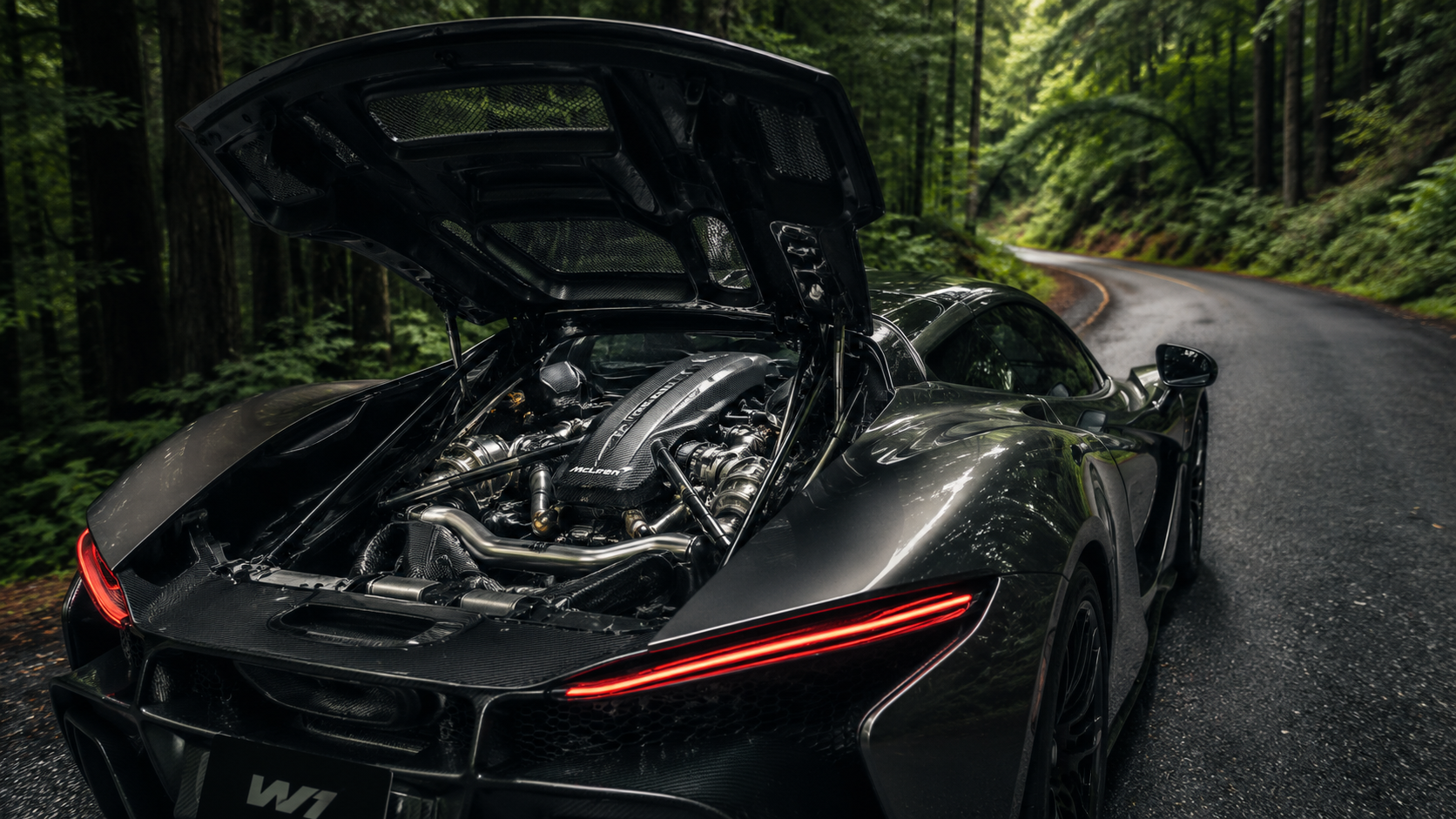
Now the real story begins, because the McLaren W1 Engine Review is the heart of this car. The W1 uses an all-new high-performance hybrid system built around a twin-turbocharged 4.0-liter V8 and an electric motor.
The engine is not just powerful, it is designed for response. McLaren’s MHP-8 V8 works with a radial-flux electric motor, giving the W1 instant torque support and huge top-end performance. Car and Driver reports combined output at 1258 hp and 988 lb-ft of torque.
The transmission also matters, because the W1 uses an 8-speed dual-clutch gearbox with electric reverse. That design saves weight and matches the car’s performance-first mission.
The performance numbers are shocking. McLaren claims 0–100 km/h in 2.7 seconds, 0–200 km/h in 5.8 seconds, a quarter-mile in under 9.6 seconds, and a 350 km/h top speed.
For drivers searching McLaren W1 Power Review, the answer is simple: this is the most powerful road-legal McLaren ever announced. The hybrid system does not exist to make the W1 soft; it exists to make the car faster, sharper, and more explosive.
0–60-MPH Times
Acceleration defines the W1, and this McLaren W1 0-60 Review proves why. McLaren claims the W1 can reach 60 mph in about 2.7 seconds, and Car and Driver repeats that figure in its W1 preview.
Even more impressive, the W1 reaches 124 mph in 5.8 seconds and 186 mph in about 12.7 seconds. Those figures move the W1 from supercar territory into full hypercar territory.
For anyone searching McLaren W1 Acceleration Review, the key point is not only how fast it launches. The more important detail is how violently it keeps pulling after 100 mph. Many cars feel quick at city speeds, but the W1 is engineered for extreme speed at track pace.
For high-speed fans, this McLaren W1 Top Speed Review confirms a claimed electronically limited top speed of 217 mph, or 350 km/h.
Range, Charging, and Battery Life
Here’s the simple answer: The W1 is a hybrid hypercar, not an electric commuter. Its battery aids performance, torque fill, electric reverse and short electric-only driving.
The W1 uses a battery of about 1.4 kWh, mounted low in the chassis to help the center of gravity, Car and Driver says. It also claims it gets about two miles of electric-only range and it takes around 22 minutes to charge to 80 percent.
That means for readers looking for a McLaren W1 Hybrid Review there is one main purpose to the electrification of the W1. Performance. The battery is not meant to replace the V8 experience. It’s there to make the V8 more lively and the car more able.
Ownership planning should include charging a performance prep step, not a daily EV routine, for buyers. The W1 is designed to attack roads and circuits, not to commute silently across town.
UI and Driving Experience
The W1’s interface is built around the driver, which makes this section important even though some users search it as “UI and Writing Experience.” In this article, we focus on the car’s UI and driving experience.
The cabin design uses a high-resolution 8.0-inch touchscreen with McLaren’s infotainment system, Apple CarPlay, USB-C connectivity, and a USB-A charging port.
The driving experience feels intentionally focused. The fixed-seat design places the driver in a race-style position, while the movable pedals and steering wheel help create a customized fit. This gives the W1 a cockpit feel that matches its track-ready engineering.
For people searching McLaren W1 Driving Experience, the main appeal is the combination of hybrid force, rear-wheel-drive balance, hydraulic steering feel, active aerodynamics, and lightweight carbon construction.
For people searching McLaren W1 Road Test Review, early driving impressions from recent automotive coverage describe the W1 as extremely fast but surprisingly usable and predictable on track. Road & Track, after driving the W1 at Mugello, described the car as powerful, engaging, and less mediated than some rivals.
Fuel Economy and Real-World MPG
Fuel economy is not the headline, because the W1 is a seven-figure hypercar designed around lap times and driver engagement. Car and Driver states that official fuel economy information is still TBD.
For real-world buyers, fuel cost will not be the main ownership challenge. Insurance, service, tires, storage, transport, and track preparation will matter far more.
Still, the hybrid system may help efficiency in low-speed operation and may reduce some load on the combustion engine in specific conditions. However, nobody should buy a W1 expecting economy-car logic.
Interior, Comfort, and Cargo
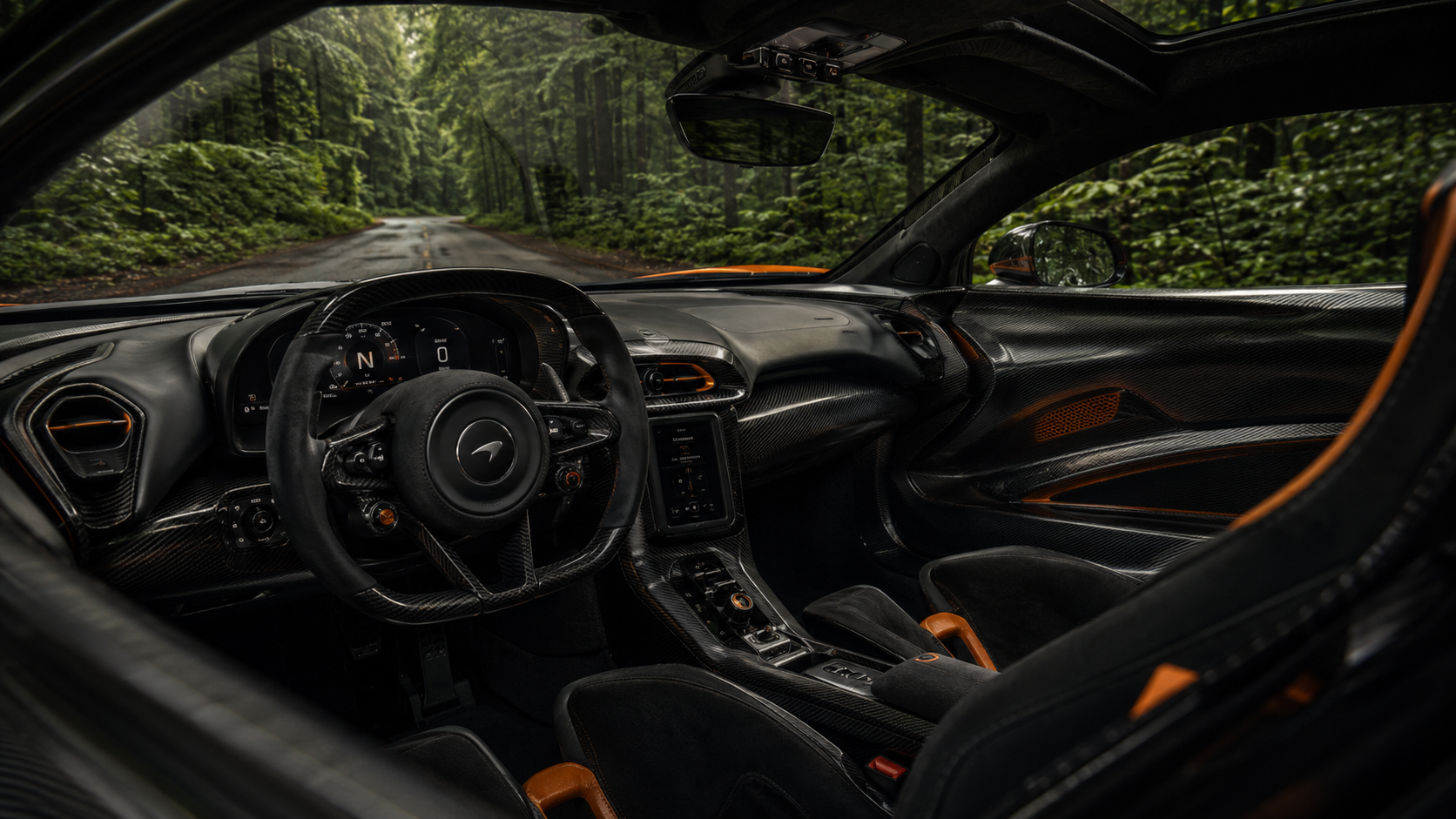
Step inside, and this McLaren W1 Interior Review shows a cabin designed for serious driving rather than soft luxury. The W1 uses fixed seats integrated into the carbon structure, while the pedals, steering wheel, and instrument binnacle move to fit the driver.
Comfort still matters, and McLaren has tried to make the interior more usable than a pure race car. The cabin includes concave door sections, small-item storage, a sliding cupholder, and about four cubic feet of storage behind the seats.
For the McLaren W1 Luxury Review, the answer is nuanced. The W1 is luxurious through materials, engineering, rarity, and customization rather than soft seats and silent cruising.
For the McLaren W1 Comfort Review, the W1 should feel more livable than a track-only machine, but it will still have the compromises expected from a low, wide, carbon-fiber hypercar.
For the McLaren W1 Interior keyword, the cabin’s biggest strengths are visibility of controls, lightweight material options, racing posture, and a sense that every detail exists for speed.
Smart Infotainment & Connectivity
The W1 is there but the technology is not dominant. The infotainment system includes an 8.0-inch touchscreen, Apple CarPlay and charging capability via USB-C and USB-A.
The best thing about this McLaren W1 Technology Review is the cabin is simple enough to drive fast. Some hypercars hide all their functions behind digital menus, but the W1 keeps the key performance controls close to the driver.
For the audiophiles out there, McLaren offers a Bowers & Wilkins audio system and the interior can be specified with McLaren’s InnoKnit material which can be woven into audio and visual elements.
The W1 is more user-friendly than previous analog hypercars for everyday use, with smartphone connectivity, charging ports, navigation, and a tidy screen layout. Still, the W1’s bread and butter isn’t entertainment, it’s performance.
Safety & Driver Assistance Features
Safety in the W1 begins with structure, because the carbon-fiber architecture gives the car a strong and lightweight foundation. The braking system, tires, stability systems, and aero balance all contribute to safety at speed.
Driver assistance is not the main focus, and buyers should not expect the W1 to behave like a luxury SUV full of semi-autonomous systems. The W1 is a driver’s hypercar, so its safety philosophy centers on control, braking, grip, visibility, and predictable handling.
For normal road use, the W1 should include essential systems such as airbags, stability control, anti-lock braking, seat-belt systems, and required market-specific safety equipment. Final equipment can vary by region, so buyers should confirm details with an official McLaren retailer.
For track use, safety also depends on tire choice, brake temperature, driver skill, and proper preparation. A W1 is not a car to drive casually at the limit without training.
Warranty and Maintenance Coverage
Ownership support matters, especially when the car costs more than many houses. Car and Driver reports that the W1 includes a four-year unlimited-mileage vehicle warranty, a six-year or 45,000-mile battery warranty, and four years of complimentary scheduled maintenance.
McLaren also notes that new McLaren cars come with comprehensive warranty support, and extended warranty or service-contract options are available in some markets.
For buyers, warranty coverage should be checked carefully before purchase because region, usage, track activity, service history, and import status can affect coverage.
For collectors, maintenance history will be extremely important. A W1 with complete authorized service records, original specification documents, and careful storage will likely be more desirable in the future.
C/D Test Report: Results and Specifications
Here is the honest note: a full independent Car and Driver instrumented road test is not the same as a preview based on manufacturer data. At the time of writing, the available public C/D page lists manufacturer-claimed performance and specifications.
The reported C/D-style specification summary includes a $2.1 million MSRP, 1258 hp, 988 lb-ft of torque, 3084-pound dry weight, 0–60 mph in 2.7 seconds, 0–124 mph in 5.8 seconds, 0–186 mph in about 12.7 seconds, and a 217 mph top speed.
For readers searching McLaren W1 Specs Review, those figures are enough to show that the W1 is one of the most extreme road-legal McLarens ever made.
For readers searching McLaren W1 Specs and Features, the W1’s key features include the hybrid V8, 8-speed DCT, active aero, carbon-fiber construction, rear-wheel drive, fixed-seat cockpit, and limited 399-car production.
McLaren W1 AirBags
Airbags are essential, but McLaren has not made airbags the headline of the W1’s public marketing. The W1 is expected to include required airbag systems for road legality in its target markets.
For buyer confidence, the most important point is to verify the exact airbag and safety equipment specification with the official dealer in your country. Hypercars often vary slightly by market because safety, lighting, and compliance rules differ.
For AutoPicker readers, this section is included because people searching “McLaren W1 AirBags” often want to know whether extreme performance has reduced basic safety. The sensible answer is that road-legal hypercars must meet legal requirements, but final specification should be confirmed before purchase.
McLaren W1 Tires and Rims
Grip defines the W1, and the tires are a major part of the story. Pirelli says it developed bespoke tires for the McLaren W1, including P Zero R, P Zero Trofeo RS, and P Zero Winter 2 fitments, with Pirelli acting as sole tire supplier for the model.
For track-focused owners, the P Zero Trofeo RS will likely be the exciting choice because it is designed for maximum dry grip and serious performance driving. For road use, the P Zero R should offer a more balanced setup.
For all-season planning, the existence of a P Zero Winter 2 fitment matters because it shows that McLaren and Pirelli considered more than warm-weather track driving.
For the rims, buyers should expect lightweight performance wheels designed to support braking, cooling, stiffness, and aerodynamics. Because W1 specifications may vary through McLaren Special Operations personalization, buyers should confirm exact wheel size, finish, and tire package with their retailer.
McLaren W1 Interior
This W1 McLaren review deserves a section of its own, as it shows how the performance mission is backed up by the interior. The W1 doesn’t have a comfort-first layout. It features fixed seats, movable controls, compact screens and lightweight materials.
The design gives a feel of occasion. The driver is low in the car, controls come in towards the body and the cabin feels sculpted around the person behind the wheel. This is not only style, it helps with packaging, weight distribution and aerodynamic efficiency.
The materials count too. Leather, faux leather, carbon-fiber trim, and McLaren InnoKnit—a stretchy, lightweight material that can be used on various cabin surfaces—are available, according to Car and Driver.
Best Features| McLaren W1 Interior is one of the best for people looking for a mixture of racing stance with enough comfort and technology to make the car feel modern.
McLaren W1 All Mirrors and Side Mirror
Even the mirrors have a job, because the W1 is shaped by airflow. Reports on the W1 design note that the side mirrors are positioned far outboard and shaped to manage air wake away from key cooling and aero areas.
That small detail matters because hypercar design is never only about appearance. Mirrors can create drag, noise, and turbulent air, so McLaren uses them as part of the overall aerodynamic package.
For drivers, mirror visibility will still be important because the W1 is wide, low, and fast. Parking, lane changes, and tight roads will require attention.
For design fans, the mirror placement adds to the car’s technical personality. The W1 looks dramatic because nearly every surface has a functional purpose.
Exterior Review
From the outside, this McLaren W1 Exterior Review shows a car that looks more functional than decorative. The W1 does not chase beauty in the traditional luxury sense. It uses vents, channels, wings, inlets, and body sculpting to control air.
The front end appears sharp and aggressive, while the side profile shows deep aerodynamic channels and dramatic door design. The rear section is dominated by cooling, diffuser work, and the active rear wing.
For the McLaren W1 Design Review, the key idea is simple: form follows performance. The W1 looks intense because the engineering demands it.
For social media and Google Images, the W1’s exterior has strong visual ranking potential because users are likely to search for front view, rear view, side profile, orange launch color, active wing, interior, and track photos.
Aerodynamics Review
Aero is the W1’s secret weapon, and this McLaren W1 Aerodynamics Review explains why. Power alone does not make a hypercar fast around a track. The car also needs downforce, cooling, brake stability, and clean airflow.
The W1 uses active aerodynamic elements to adjust its behavior depending on speed and mode. Car and Driver reports maximum downforce of up to 2205 pounds, which helps the W1 remain stable under high-speed cornering and braking.
The active rear wing is especially important because it extends and changes the car’s aerodynamic balance. This allows the W1 to act more slippery in some conditions and more planted in others.
For track drivers, aero confidence can matter as much as horsepower. When a car reaches 200 mph territory, stability becomes everything.
Track Review
On track, the W1 should feel like McLaren’s most focused road-legal weapon. This McLaren W1 Track Review focuses on power delivery, aero balance, steering response, braking strength, and driver confidence.
The rear-wheel-drive layout makes the car exciting, but also demands skill. Unlike all-wheel-drive hypercars that use front motors to pull out of corners, the W1 asks the rear tires to manage huge hybrid torque.
The active aero should help build trust at speed, while the hybrid torque should make corner exits explosive. Recent Road & Track driving coverage described the W1 as extremely quick yet predictable and accessible on circuit.
For owners, proper track preparation will be essential. Tire pressure, brake condition, battery state, cooling, and driver coaching can make the difference between a safe session and an expensive mistake.
First Look Review
At first glance, the McLaren W1 First Look Review is about shock value. The car looks lower, wider, more technical, and more aggressive than a typical McLaren road car.
The launch design makes a clear statement. The W1 is not trying to be subtle. It wants buyers to know that this is the new top-level McLaren.
The biggest first-look takeaway is that the W1 is more than a P1 replacement. It represents a new phase of McLaren performance, where hybrid power, active aero, and carbon engineering become even more connected.
For AutoPicker readers, the first impression is simple: the W1 looks like a road car designed by people who think about lap times first.
Limited Edition Review
Exclusivity makes the W1 more desirable, and this McLaren W1 Limited Edition Review explains why. Only 399 cars are planned, and McLaren says they are already customer allocated.
That limited number matters because halo McLarens often become important collector cars. The F1 became legendary. The P1 became a hybrid-era icon. The W1 now enters that same conversation.
For collectors, specification will matter heavily. Color, interior trim, MSO options, mileage, service records, and ownership history could influence long-term value.
For buyers who missed allocation, the secondary market may be the only path, but prices can be unpredictable.
Buyer Guide
This McLaren W1 Buyer Guide recommends asking five practical questions before you buy. First, can you actually get an allocation or verified resale car? Second, do you have authorized service access? Third, do you want to drive it or store it? Fourth, do you know about tire and maintenance costs? Fifth, is it an emotional buy, an investment, or for track use?
Thinking about buying a McLaren W1 Review? The answer to the question, “is the W1 worth considering?” is yes if you want one of McLaren’s most important modern cars and can afford the cost of ownership.
If you are asking Is the McLaren W1 a Good Buy then yes it is for collectors and expert drivers but no if you need comfort, ease of use or low running costs.
Is the McLaren W1 Worth It? If you care about rarity, McLaren heritage, hybrid V8 performance and extreme engineering over practicality, then the W1 is worth it.
Hidden Features
Some of the best details are easy to miss, which makes the McLaren W1 Hidden Features topic useful. The electric reverse system removes the need for a conventional reverse gear, saving packaging and weight.
Another hidden advantage is the low battery placement, which helps the center of gravity and supports handling balance.
A third clever feature is the fixed-seat layout with movable controls. It may sound unusual, but it helps structure, weight, and driver positioning.
A fourth special detail is the aerodynamic mirror shaping. Even a small part like a mirror can influence airflow around the radiators and active wing.
A fifth hidden feature is the way McLaren uses materials inside the cabin, including lightweight InnoKnit and carbon-fiber trim options.
Comparison Review
This McLaren W1 Comparison Review shows that the W1 enters one of the strongest hypercar battles ever.
McLaren W1 vs Ferrari F80
The Ferrari F80 is the obvious rival, because both cars represent new-generation hybrid hypercar thinking. The F80 uses a hybrid V6 layout and more electronic complexity, while the W1 keeps a hybrid V8 and rear-wheel-drive layout. Ferrari’s official F80 information confirms its role as the brand’s flagship successor to LaFerrari.
McLaren W1 vs Bugatti Tourbillon
The Bugatti Tourbillon is a different kind of monster. Bugatti uses an 8.3-liter naturally aspirated V16 hybrid system, and Bugatti positions the Tourbillon as the successor to the Chiron. The W1 feels more track-focused, while the Tourbillon feels more like a luxury engineering sculpture.
McLaren W1 vs Aston Martin Valkyrie
The Aston Martin Valkyrie brings race-car drama, especially through its extreme aero and high-revving character. The W1 counters with hybrid V8 power, McLaren usability, and active aero refinement.
McLaren W1 vs Porsche 918 Spyder
The Porsche 918 Spyder helped create the hybrid hypercar era, but the W1 belongs to a newer generation. The McLaren has far more power and a more modern aero package, while the Porsche remains one of the best examples of usable hybrid supercar engineering.
McLaren W1 Supercar Review
Some people call it a supercar, but the W1 really belongs in hypercar territory. This McLaren W1 Supercar Review uses the term because many readers search that phrase, but the performance numbers clearly go beyond normal supercar standards.
A supercar is fast, but a hypercar changes the conversation. The W1 does that with its hybrid V8, active aero, carbon structure, limited production, and extreme acceleration.
For everyday car fans, the W1 is not relatable in price, but it is important because its technology may influence future McLaren models.
McLaren W1 Most Powerful McLaren
This is the headline many people care about: the W1 is the most powerful road-legal McLaren announced to date. McLaren lists output at 1275 PS, while Car and Driver reports 1258 bhp.
That title matters because McLaren has already built icons like the F1, P1, Senna, Speedtail, and 765LT. For the W1 to sit above them in power gives it instant historical importance.
Power alone is not enough, but McLaren combines that output with low dry weight, rear-wheel drive, and downforce. That is why the W1 feels special on paper before it even turns a wheel.

Final Verdict
Final AutoPicker verdict: The McLaren W1 is one of the most significant hybrid hypercars of the 2026 era. It’s brutally fast, technically advanced, emotionally focused and rare enough to be a major collector car.
The W1 is not for buyers, it’s not easy to get, it’s not cheap. But it’s exactly what a halo McLaren should be. Extreme, lightweight, aerodynamic, dramatic, built around the driver.
The W1 shows enthusiasts that hybrid tech doesn’t have to make cars boring. If done right, electrification can make a V8 hypercar even more exciting, sharpen throttle response and boost performance.
This is the answer for searchers who are looking for McLaren W1 Review AutoPicker. The W1 is not another expensive car. It’s McLaren’s next chapter after the P1 and, if history repeats, it could become one of the defining hypercars of this decade.
Visit Official Website : ClickHere